
Introduction
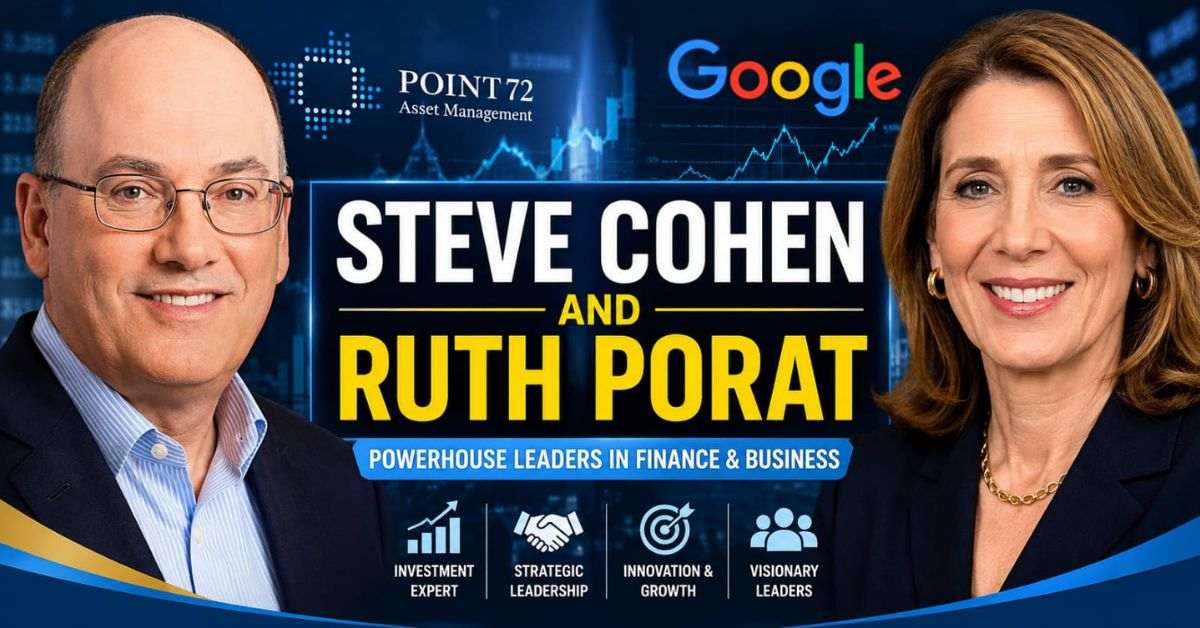
If you want to understand where the artificial intelligence boom is really heading in 2026, you need to look past the chatbots and follow the money. Two names keep showing up at the center of that story: Steve Cohen and Ruth Porat. One is a hedge fund billionaire who owns the New York Mets. The other is the executive who controls how Alphabet, Google’s parent company, spends its enormous cash pile. They work in different worlds — Wall Street trading floors and Silicon Valley boardrooms — yet both are making decisions right now that will decide which AI companies win, which data centers get built, and how much money flows into the technology that is reshaping everyday life. This article breaks down who they are, what they do, and why their choices matter to anyone watching the AI economy grow. We will keep the explanations simple, back everything with current facts, and show you exactly what these two leaders have been doing through the middle of 2026.
Who Are These Two AI Economy Power Players?
The two executives come from very different corners of finance, but both now sit at the center of the AI investment story. Steve Cohen is the founder and chairman of Point72 Asset Management, one of the world’s largest hedge funds, and he is also the owner of Major League Baseball’s New York Mets. Ruth Porat is the President and Chief Investment Officer of Alphabet and Google, a role she took on in September 2023 after eight years as the company’s chief financial officer. Cohen decides where a $50 billion trading firm places its bets. Porat decides how one of the biggest technology companies on earth spends its capital. Together, they represent two sides of the same coin: the investors betting on AI’s future, and the executives building the infrastructure that AI needs to run.
Steve Cohen’s Rise: From Trading Floor to Billionaire Investor
Steve Cohen was born in 1956 and grew up in Great Neck, New York, where he first learned to take calculated risks playing poker with friends. He built his early career as a trader before founding SAC Capital Advisors, which grew into one of the most talked-about hedge funds on Wall Street. After SAC pleaded guilty to securities fraud charges in 2013, Cohen relaunched his business as Point72 Asset Management in 2014. Point72 has since become a multi-strategy powerhouse with roughly $50 billion in assets under management and more than 200 investing teams covering equities, macro trading, private credit, and venture capital. In 2020, Cohen bought the New York Mets for $2.4 billion, becoming one of the most recognizable owners in professional sports. According to Bloomberg’s hedge fund pay rankings, Cohen earned an estimated $3.4 billion in 2025, topping the industry for the first time.
Ruth Porat’s Rise: From Morgan Stanley to Alphabet’s Top Office
Ruth Porat spent 27 years climbing the ranks at Morgan Stanley, eventually becoming its chief financial officer in 2010. She joined Google in 2015 as CFO, where she became known for tightening spending on risky side projects while still backing long-term technology bets. In 2024, she moved from CFO to a newly created role: President and Chief Investment Officer of Alphabet and Google. In this position, she oversees the company’s investment vehicles, including GV and CapitalG, its Other Bets portfolio, and its real estate and infrastructure decisions. She also represents the company to governments and regulators shaping AI policy. Porat holds a degree from Stanford University, and according to <a href=”https://www.stanford.edu” target=”_blank” rel=”noopener”>Stanford’s own records</a>, she has remained closely tied to the school’s research community throughout her career.
Why Wall Street and Silicon Valley Are Both Watching Them
Steve Cohen and Ruth Porat sit at two different pressure points of the same AI economy, which is exactly why both are getting so much attention in 2026. Cohen’s hedge fund decides which AI-related stocks get bought or sold, moving billions of dollars in and out of chipmakers, cloud companies, and data center operators within weeks. Porat’s decisions determine whether those same companies actually receive the capital they need to expand. When Alphabet raises or lowers its spending plans, the ripple effects hit semiconductor firms, construction companies, and power utilities almost overnight. Investors read Porat’s public comments the same way traders read a central bank announcement. Meanwhile, hedge funds like Point72 study Alphabet’s spending patterns to decide where the next profitable trade might be hiding. This constant back-and-forth between investor money and corporate spending is what makes the AI boom function, and it is why two people working in completely separate industries have become must-watch figures for anyone following technology news.
Explore the influence of Steve Cohen and Ruth Porat on finance and AI with insights from Adsyfire com.
Steve Cohen’s AI Investment Playbook at Point72
Point72 has leaned hard into artificial intelligence over the past year. The firm’s dedicated AI strategy, called Turion and led by portfolio manager Eric Sanchez, reportedly gained around 15% in a single month in early 2026 and has grown to nearly $4 billion in assets. In February 2026, regulatory filings showed Point72 placing $2.8 billion into five major AI-related companies, including large positions in Taiwan Semiconductor, Nvidia, Amazon, Equinix, and Broadcom. Rather than chasing only the best-known AI software names, Cohen’s team has focused on what people call the “AI supply chain” — chips, memory, data center space, and networking equipment. Point72 has also grown positions in AMD and Broadcom while trimming profits from some of its earlier winners, a pattern that shows a firm trying to stay ahead of the trend rather than simply riding it. This approach reflects Cohen’s long-standing reputation for spotting emerging themes early and building specialized teams around them instead of relying on one big bet.
Ruth Porat’s Role in Google’s Massive AI Spending
Few executives control as much AI-related capital as Ruth Porat. Alphabet spent $91.4 billion on capital projects in 2025 and has projected spending of between $180 billion and $190 billion in 2026, the largest infrastructure commitment in the company’s history. Porat oversees how that money gets allocated across data centers, chips, and energy deals needed to keep Google’s AI tools, including Gemini and NotebookLM, competitive. She has also become the public face of Alphabet’s relationships with local communities and government regulators as new data centers get built across the country, often addressing concerns about energy use and job creation directly. At the Economic Club of New York in June 2026, Porat argued that data centers create local jobs and help spread energy costs across a wider base, pushing back against critics who worry the AI buildout is moving too fast without enough public benefit.
Shared Optimism About AI’s Future
Despite sitting on opposite sides of the table, Steve Cohen and Ruth Porat appear to share a similar belief: artificial intelligence is not a passing trend but a long-term shift that deserves serious capital. Porat has publicly argued that AI will fuel a productivity revolution capable of adding trillions of dollars to the U.S. economy, and she has pushed back firmly against so-called “AI doomers” who worry the technology is overhyped. Cohen’s trading decisions tell a similar story. Instead of pulling back during periods when AI stocks looked shaky, Point72 kept adding to chip and infrastructure positions, treating short-term dips as buying opportunities rather than warning signs. Neither leader has ignored the risks entirely — both have acknowledged that spending this large brings real financial exposure — but their actions in 2026 show two of the most powerful people in finance and technology are still leaning firmly toward growth.
Steve Cohen and Ruth Porat by the Numbers: A Quick Snapshot
Numbers tell this story faster than words. The tables below lay out where each leader stands in the middle of 2026, based on public filings and reported figures.
Table 1: Quick Profile Comparison
| Category | Steve Cohen | Ruth Porat |
| Current Title | Chairman & CEO, Point72 Asset Management | President & Chief Investment Officer, Alphabet/Google |
| Industry | Hedge fund / alternative investing | Big Tech / corporate finance |
| Career Start | Trader, Gruntal & Co., 1978 | Morgan Stanley, 1996 |
| Signature Move | Launching the Turion AI fund | Overseeing record AI infrastructure spending |
| Public Profile | Owner, New York Mets | Board member, Blackstone Inc. |
Table 2: 2026 Key Figures
| Metric | 2026 Figure |
| Point72 assets under management | Approximately $50 billion |
| Point72’s Turion AI fund assets | Nearly $4 billion |
| Cohen’s reported 2025 earnings | $3.4 billion (Bloomberg ranking) |
| Alphabet’s 2025 capital expenditure | $91.4 billion |
| Alphabet’s projected 2026 capital expenditure | $180–$190 billion |
Risks and Criticism Both Leaders Face
Not everyone is convinced this level of spending and investing is wise. Some market veterans, including well-known short-seller Michael Burry, have warned that AI stock valuations are stretched too far and could fall sharply if profits do not catch up to the hype. Critics of Alphabet’s spending plan point out that pouring close to $190 billion into infrastructure in a single year is a massive bet that assumes AI demand keeps climbing without interruption. Porat has also faced public criticism for her friendly tone toward government officials while defending the company’s regulatory interests, with some observers arguing tech leaders are too eager to please policymakers. On the hedge fund side, Point72 carries the usual risks of concentrated, fast-moving trades — a strategy that gained 15% in one month can lose just as quickly if sentiment turns. Both Steve Cohen and Ruth Porat are operating in a market where confidence is high, but so are the stakes if that confidence cracks.
What This Means for Investors and Tech Watchers
For everyday investors and technology readers, the moves made by these two leaders offer a useful signal, not a guarantee. When a hedge fund the size of Point72 adds billions to chip and data center stocks, it usually means professional researchers see real earnings potential ahead, not just hype. When a company as disciplined as Alphabet commits close to $190 billion to infrastructure, it signals genuine confidence that AI demand will keep growing for years, not months. Still, following any single investor’s playbook without doing your own research is risky. According to filings tracked by the <a href=”https://www.sec.gov/cgi-bin/browse-edgar?action=getcompany” target=”_blank” rel=”noopener”>U.S. Securities and Exchange Commission</a>, hedge fund positions can shift quickly from quarter to quarter, so what looks like conviction today could change by the next filing. The safest approach is to treat these moves as one data point among many, alongside company earnings, industry trends, and your own financial goals. For a deeper look at how AI infrastructure spending is reshaping the broader market, see our related coverage on AI infrastructure investment trends and how hedge funds are positioning for the AI supply chain.
Frequently Asked Questions (FAqs)
Are Steve Cohen and Ruth Porat business partners?
No. They lead separate companies in different industries and have no known formal business partnership; they are connected only through the shared AI investment trend.
How much has Point72 invested in AI companies in 2026?
Point72 disclosed roughly $2.8 billion in new AI-related stock positions in February 2026, alongside a dedicated AI fund worth close to $4 billion.
What is Ruth Porat’s exact job title at Google?
She is the President and Chief Investment Officer of Alphabet and Google, a role she has held since September 2023.
Why is Alphabet spending so much money on AI infrastructure?
Alphabet needs massive data center and chip capacity to keep AI tools like Gemini competitive, with 2026 spending projected as high as $190 billion.
Does Steve Cohen still run Point72 day to day?
Yes, Cohen remains chairman and CEO and leads the firm’s new executive committee, though he now shares investment duties with co-CIO Harry Schwefel.
Conclusion
Steve Cohen and Ruth Porat may never share a boardroom, but their decisions are quietly steering the same AI economy from opposite directions. Cohen’s trading desk moves billions in and out of AI-linked stocks based on where his research teams see the next winning trend. Porat’s office decides how much of Alphabet’s vast cash reserve actually gets built into real data centers, chips, and power deals. Both are placing enormous confidence in AI’s long-term future, even as skeptics warn about stretched valuations and untested returns. For readers trying to make sense of where the technology industry is headed next, watching how these two continue to invest, spend, and speak publicly in the coming months will offer real clues. Keep following our technology news coverage for updates on Point72’s next moves, Alphabet’s spending reports, and the broader AI investment story as it unfolds through the rest of 2026.